Desktop · 0.7–1.5 m
Tikpal Near
AvailableA compact two-way monitor engineered for the first metre — desks, consoles, and small rooms where the listener sits close.
Part of Tikpal Room · Engineered by Tikpal Audio
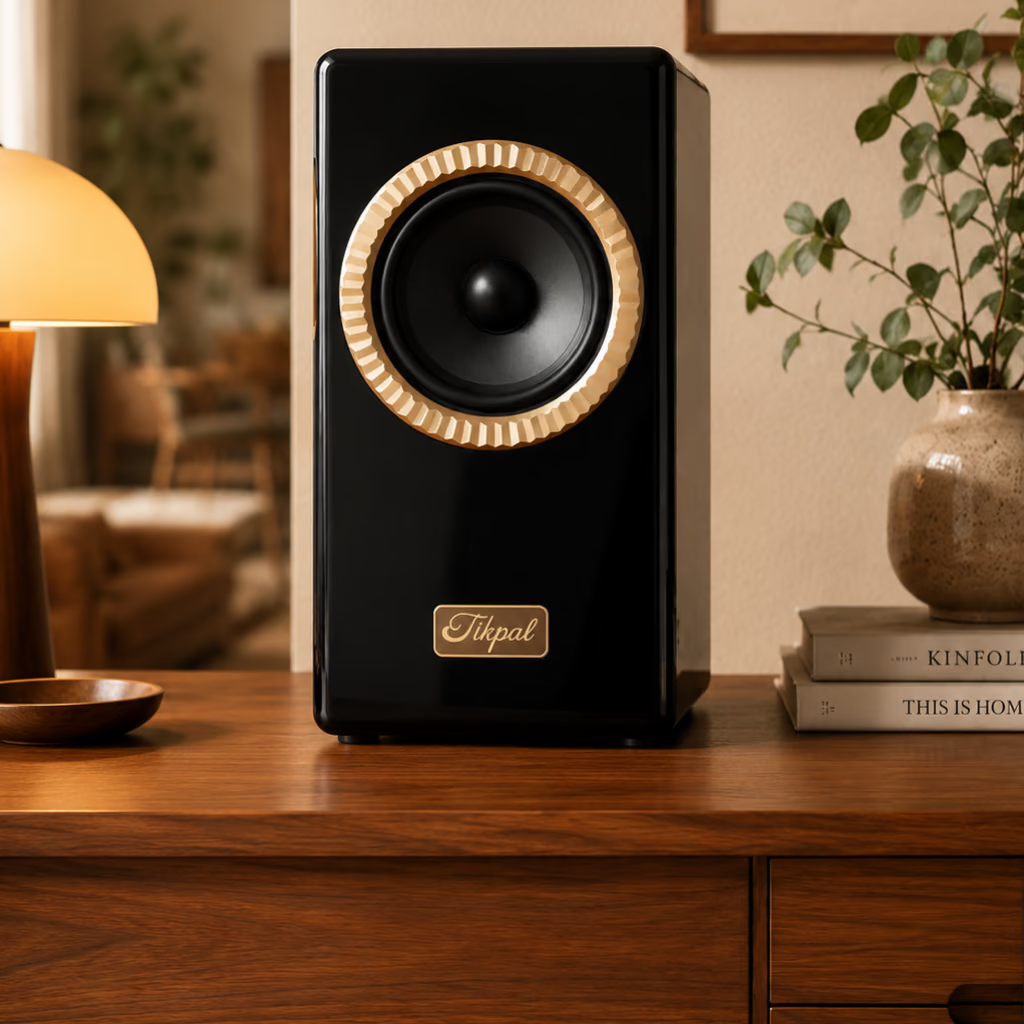
Where it lives
Desktop · 0.7–1.5 m
Made for desks, consoles and near-wall placement. The geometry is tuned for the first metre, so the crossover arrives at your ears almost undiluted by the room.
-
Built for the first metre
Baffle width and driver spacing are chosen so the crossover region sums cleanly at short listening distances — a nearfield design, not a shrunken floorstander.
-
Forgiving placement
Front porting and an enclosure tuned for desk-boundary behaviour keep the speaker usable near walls, where nearfield speakers actually live.
-
One family voice
The waveguide-loaded tweeter and voicing philosophy are inherited from the Reference program, so timbre matches when models are mixed in a room.
Structure & waveguide
Structure & waveguide close-up photography is in preparation
Structure & waveguide close-up photography is in preparation
The measurements
What the measurements say
Acoustic prototypes are being built and waveguide simulation is complete. The first on-axis and directivity sweeps appear in the Audio Lab as soon as they exist — until then this page deliberately shows no graphs.
Specifications
Specifications are provisional
| Format | Two-way passive stand/desk monitor |
|---|---|
| Drivers | 4.5" mid-bass, 1" soft-dome tweeter (waveguide loading planned) |
| Crossover | Passive, ~2.2 kHz (provisional) |
| Recommended distance | 0.6 – 2 m |
| Sensitivity | ~84 dB / 2.83 V / 1 m (provisional) |
| Impedance | 8 Ω nominal |
Development log
- Nearfield-first geometry: baffle width and driver spacing chosen so the crossover region sums cleanly at short listening distances.
- Waveguide-loaded tweeter inherited from the Reference program to control directivity at the crossover.
- Compact enclosure tuned for desk-boundary behaviour, with front porting to keep placement forgiving.
- Same voicing philosophy as the Tikpal Reference, so timbre matches when models are mixed in a room.
Why nearfield
Most listening happens close to the speakers — a desk, a console, a bedside. At those distances the room contributes less and the speaker itself contributes more: baffle step, driver spacing and the crossover sum arrive at your ears almost undiluted. The Tikpal Near is designed around that fact instead of shrinking a floorstander.
Design notes
The mid-bass unit is chosen for linearity well below its crossover point, so the tweeter never has to work into its breakup region. The waveguide keeps horizontal directivity smooth through the crossover — the same target we chase in the Reference program — which keeps the tonal balance stable as you move your head a few centimetres, the way you actually do at a desk.
The enclosure is front-ported because nearfield speakers usually live near a wall. Rear ports punish exactly that placement; we designed for reality instead.
What we measured
Acoustic prototypes are being built. Simulation of the waveguide and enclosure is complete; the first on-axis and directivity sweeps will appear in the Audio Lab as soon as they exist. Until then there are no published graphs — this page deliberately shows none.
Stay close to this build
Status changes here first — the button below tracks it automatically.