Software-Defined Amplification
prototypeAmplification
Why volume control moves into the PCM domain — and how a pure digital playback chain, a software control plane and joint calibration form one reusable audio platform.
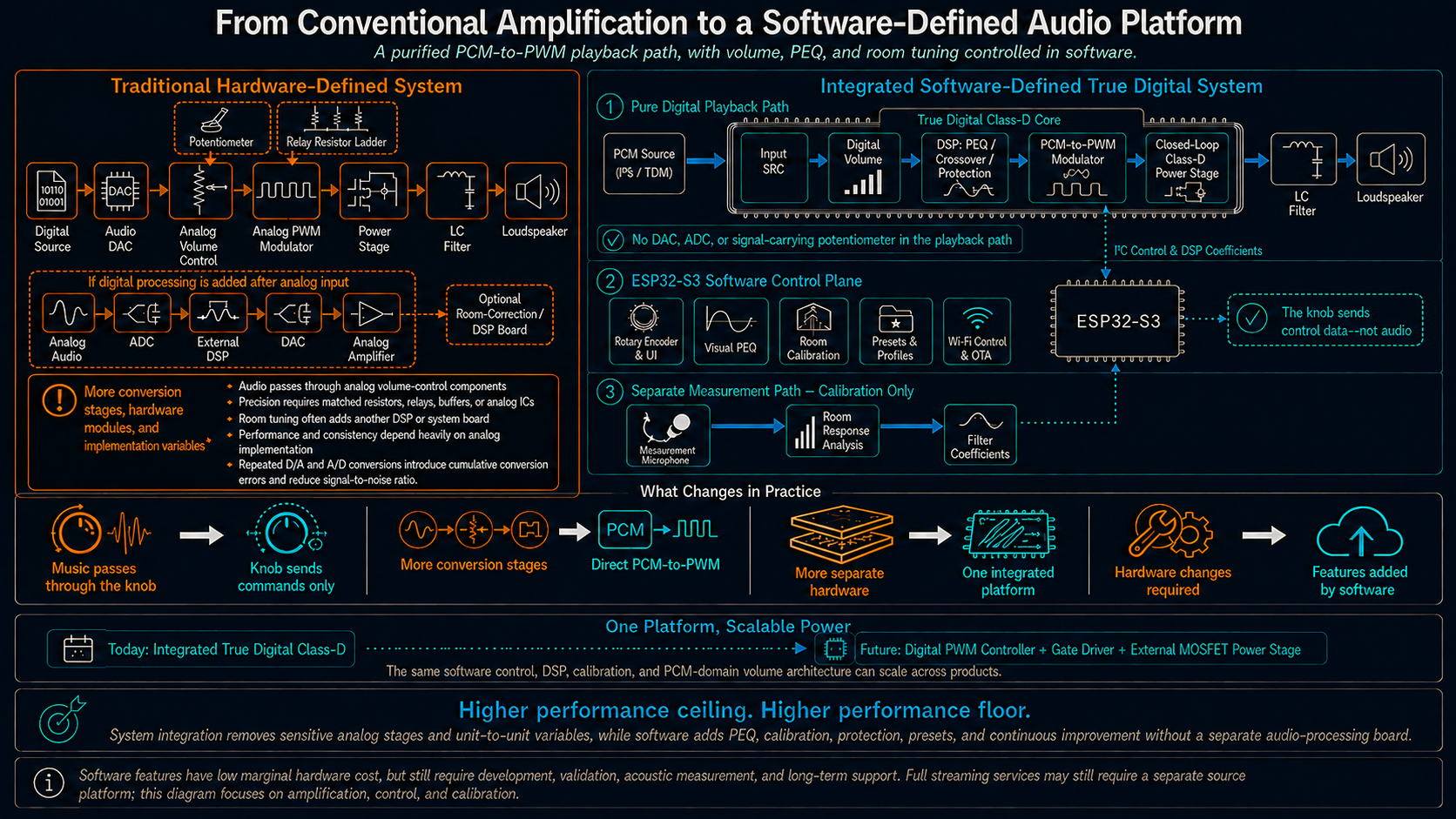
1 — The conventional compromise
A traditional amplifier has to control volume on a fragile analogue signal. Manufacturers either pay for precision — matched resistor ladders switched by relays, or expensive potentiometers — or they convert the analogue signal to digital, process it, and convert it back again. Both routes carry a cost:
- Audio passes through analogue volume-control components whose channel matching, noise and impedance behaviour depend on parts quality and ageing.
- Adding digital processing after an analogue input stacks ADC, external DSP and DAC stages; every round trip adds cumulative conversion error and erodes signal-to-noise ratio.
- Performance and consistency depend heavily on analogue implementation tolerances, unit to unit.
2 — Volume in the PCM domain
Tikpal controls volume where the music already lives: in the PCM domain, at the source of the chain. The rotary knob sends control data — never audio. The playback path contains no mechanical contacts, no analogue potentiometer and no external conversion stages:
- PCM arrives from the source (I²S / TDM).
- Input selection, digital volume, PEQ / crossover and protection run in the DSP.
- The processed PCM is modulated directly to PWM.
- A closed-loop Class-D power stage drives the loudspeaker through the LC filter.
Shortening the path is only half of the argument. Doing volume in software removes, by construction, the matching, noise, impedance and cost problems that analogue volume control has carried for decades.
3 — Three planes, not “an amp with digital features”
The architecture is no longer “a conventional amplifier with some digital features added”. It is three distinct planes:
- A software-defined control plane — the ESP32-S3 handles the encoder and UI, visual PEQ, presets, Wi-Fi control and OTA.
- A deterministic real-time audio plane — a dedicated real-time DSP runs the PCM-to-PWM modulation with sample-accurate timing, independent of the control plane.
- A highly integrated power plane — the closed-loop Class-D output stage and LC filter.
The knob talks to the control plane over I²C; only coefficients and commands cross that boundary, never the signal itself.
4 — Four-layer joint design
The barrier is not any single chip. It is the joint design of four layers:
- A pure digital playback chain — PCM to PWM with no signal-carrying DAC, ADC or potentiometer in the path.
- The S3 software-defined control platform — features arrive as software, not as hardware revisions.
- The real-time DSP and power stage — PEQ, crossover and protection executed where the modulation happens.
- Joint calibration of room, drivers and amplifier — a separate measurement path (microphone, room-response analysis, filter coefficients) feeds calibration data in; it never sits in the playback path.
5 — A platform, not a board
This is not a simple amplifier board. It is a software-defined audio platform that every future Tikpal product can reuse. The same software control, DSP, calibration and PCM-domain volume architecture scales across products:
- Today: an integrated true-digital Class-D stage.
- Future: a digital PWM controller plus gate driver and external MOSFET power stage for higher power — with the same control and calibration software on top.
6 — Honest boundaries
Software features have low marginal hardware cost, but they still require development, validation, acoustic measurement and long-term support. Full streaming services may still need a separate source platform; this project covers amplification, control and calibration — and every performance claim above will, as always in this lab, be backed by published measurements as they are taken.